We’re usually wrong, but maybe not this time.

6360480891260912981296818674_music-world-music-world-1280x9602


So someone on Twitter a few days ago was scoffing that Americans always seem to think America is the one place K-pop groups long to conquer. They were implying such a view is no more than pure xenocentrism.

Here’s the thing, though: from a business and cultural point of view, it’s actually correct.

For twelve of the last thirteen years, the US music market has outstripped every other market. The one year it didn’t, that title went to Japan. And while Japan has been a close second for many of those years, since 2014, it’s been close to half of what the US consumes. (I’m looking at IFPI numbers, here. https://en.wikipedia.org/…/Global_music_industry_market_sha…)

Beyond that, if you ask a K-pop idol whom they idolize, the answer is usually either another Korean artist or, very frequently, an American artist or group. They’re aware that the cultural roots of K-pop are American. They’re aware that the market here is vast and monolithic. They might not know who The Beatles were, but they’d appreciate the apocryphal (and not true) story of the Fab Four refusing to come to the US til they had a Number One Hit here.

Almost all K-pop groups take aim at Japan. Usually quite successfully. And I have to think that’s got a measure of cultural pride, there, since Korea’s only been out from under Japan’s thumb for 70 years. Korea definitely has something to prove to its one-time occupier. Same for China, where K-pop groups frequently toured until the THADD missile crisis turned cultural relations decidedly frosty.

American are, let’s not sugar-coat it, global snobs. We all too frequently DO think the rest of the world should want to be us. But in this particular case, it’s simple business logic for Korean agencies to aim their protégées at the US market. We’re one country with an insatiable appetite for music and millions upon millions of potential consumers. Is there a market for the slick, pure pop coming out of Korea? That’s a whole other matter. But with K-pop running the gamut from Hard-edged FT Island to Gothic VIXX to sunshine-pop Astro, there’s something for everyone.

So if K-pop can establish its niche– which, I’ll admit, is going to be difficult in a country that moved on from mass appreciation of pure pop music years ago– then the sky’s the limit, here. Americans are xenocentric about countless things, but for once, I think this time we might be right.


(Image from here)
Who is Lolita?

https://strawberry-peach-tae.tumblr.com/post/159754623302/how-is-this-even-legal


A snapshot. A brief moment. An idol departing through Incheon, playing with his fans for that last moment before he disappears into the parts of the airport where they can’t see him any more. One last minute of the game, before it’s slog your way to the trains, then to your gate to wait for your flight. One last playtime.

There are a few things you can take for granted, here. Like, Wonho (this is, in case you don’t know, Wonho of Monsta X) is hyper-aware of his fans on the public-area catwalk above him. His fans, most likely female, are hyper-aware of him. He knows without question the smallest gesture he makes will be on Tumblr and Twitter and eight hundred fansites within an hour. Over and over again. Fans will deconstruct what he’s wearing, what he’s carrying, who stood closest to him, how his eyes looked, if he’d lost or gained weight, how much his shoes cost, and what, if anything, he said to anyone. He’s lived this life for a few years now; he knows how the game is played.

What I find fascinating, though, is how he’s playing it.

Wonho is, in case you can’t tell under that shirt, built. Very muscular, and not afraid of taking his shirt off when the mood or need for fan service strikes. His group is known for aggressive, powerful songs, videos, and choreography. Yet at the same time they’re playing to traditional masculine gender roles– one of their recent videos, 2016’s “Fighter” showed Wonho in jeans and a welder’s apron and little else besides sweat, hammering away at an anvil, heedless of such petty things as, you know, sparks and fire– they’re also expending as much energy again subverting them, showing themselves as soft, vulnerable, even what Westerners would call feminine.

In their own web series, “Monsta X-Ray,” they became teacher’s aides for a day, donning aprons and helping with classes of babies and toddlers, feeding them and cuddling them and carrying them. Social media will never allow to die the images of 6′ Hyungwon clearing a kindergarten lunch table with one hand while, with the other, holding a sleepy, cranky baby who refused to be put down. (Little Siwoo was dubbed “Hyungwon’s Koala Baby.”) The segment of the group putting the children down for naps and ending up napping beside them was near-murderous in its cuteness.

Which brings us back again to the image of Wonho on the people-mover, watching his fans watching him.

It’s hard to tell, but it’s likely his eyes, behind the huge sunglasses over which he coyly peeks, are kohl-rimmed. His skin is perfect, mouth enticingly red, hair sleek. He all but bats his lashes at the observers, then touches his mouth, and smiles knowingly. Add a lollipop, and he’s the cover art for Kubrik’s 1962 “Lolita.”*

But who’s seducing whom, here?

The primary audience for K-pop is, I am aware, not women my age, who’ve been around and seen some things. It’s girls: teen and pre-teen, papering their walls with posters and dreaming about idols between high-school classes. Pop stars have always been the bridge for young people between first adolescent romantic fantasies and real life– a safe way of exploring feelings before actual humans are involved. Idols occupy a space that’s both incredibly real, and completely imaginary: they’re a kid’s first love, and her imaginary friend. They’re flesh-and-blood people who eat ramyun and play video games, and they’re perfect, untouchable beauties with unlimited romantic and sexual potential.

In Korea, however, there’s far less of the toxic masculinity we have here in the US, that says a man must be a man: guns and violence and dominance and inflexibility and no time for such pansy-ass things as “emotions.” In Korea, there is no shame in a man crying at beautiful poetry, or a letter from his mother. In K-pop, there is no shame in an idol batting his lashes and giving come-hither looks to girls. He is both predator and prey at once, and he walks the line with skill.

And sometimes, a lollipop.


*I should make it clear, here, that I’m not referring so much to Nabokov’s Lolita as written, but the strange symbol she has become in Western culture: no longer the broken victim of prolonged sexual abuse, but the youthful seductress, sexually experienced yet still maintaining a veneer of innocence.

Jinja?

IMG_9109

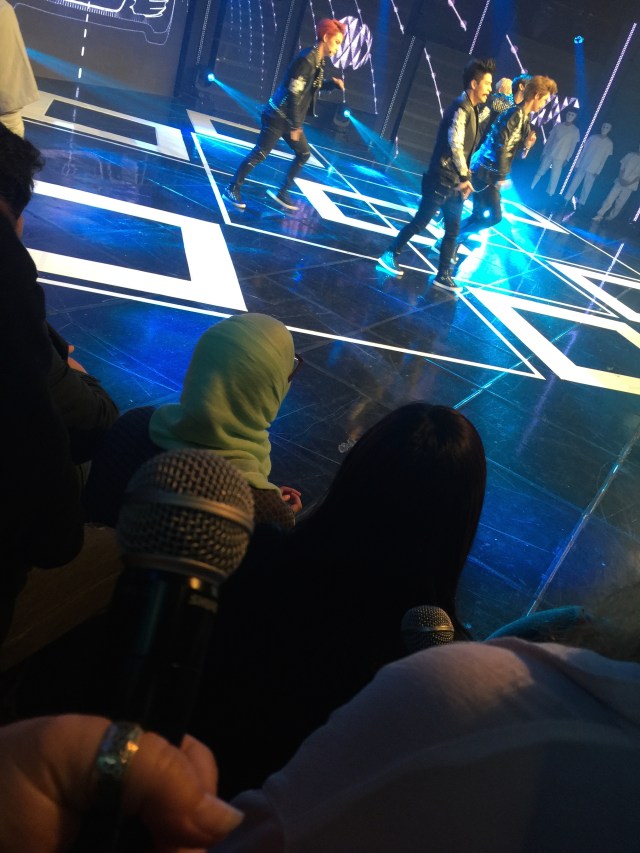
That’s my hand, with “my” mic. I’d just introduced Cross Gene on Simply K-pop. That’s them, performing. I probably shouldn’t have taken that shot. Shh. Don’t tell anyone. (April 2015)


What’s all this, then?

Here’s my deal:

Hop in a TARDIS, head back a few decades, and look me up. You’ll find me capping off a lifetime-til-then of hysterical devotion to pop music by pursuing a split major  undergrad degree in Literature (19th Century Novel, Children’s Literature, and Folklore, amongst others) and Music, which I kept to Voice and– significantly– Ethnomusicology. I even spent a year in London, ostensibly to study writing and such, but actually spending an inordinate amount of my time going to the theatre, and immersing myself in the perfection of Britpop in clubs and the record stores of Oxford Street. At the time, I had the idea of being a rock star and author. Failing that, record producer and author. Failing that, not a clue on earth. In the end, I wound up running away and joining the circus, essentially, but that’s another story entirely.

Throughout my years and my travels, I followed pop music as it moved across genres: from   British import to mainstream American radio, until the mainstream shifted to New Jack Swing and hip hop and grunge, and pop music hid out in Country. Eventually, the jingoism and misogyny of Country drove me away from radio entirely, and I hibernated with my Goth and Futurepop and waited for a pop music revival.

Fast-forward to about three years ago: home recuperating from a hospital visit that made me rather ridiculously cranky, I idly flipped through my new cable lineup and found this new channel: Mnet. Now, several years previously, I’d gotten sucked into the trope-fest that is your typical K-drama by the glory of none other than Rain, that handsome devil. So I was already favorably disposed when my television filled with handsome young men with their perfectly-choreographed precision dancing and their equally perfect precision eyeliner.

At long last, I’d discovered where perfectly-crafted, beautifully produced pop music had gone: South Korea. Here was the unabashed devotion to melody and rhythm and the ardent pursuit of the perfect hook. Here were immersive, no-expense-spared concept videos. Here were the elements of style and feel that I hadn’t seen since before MTV forgot what the M stood for. Then my long-abandoned ethnomusicology training kicked in, and I looked deeper, and found an entire culture to explore:  young men and women who trained  so hard and for so long they made Olympic gymnastics hopefuls look like slackers. A dynamic in which idols enabled and encouraged their fans to think of them as real, if mostly untouchable, boy or girlfriends. And only mostly untouchable: K-pop fans enjoy a level of closeness with their idols that would be unthinkable in the West. Constant appearances, fan signs, guerrilla-marketing surprise shows, and opportunities after every show to meet and touch hands.

So here we are. I’ve stopped listening to Western-produced music. My voice training is in shreds because I can’t yet sing in Korean. (I’m learning to read it, though, know a few basic words and phrases, and am working my way up to speaking the language.) When my favourite group is promoting, I take it as a matter of course I’ll be getting up every morning at 4am to watch Korean music shows online. I spent ten days in Korea last spring, and will be heading back in a few weeks for a two-week trip. I’ve spent an entire day at a K-pop show taping, and even, with one of my friends, got to introduce a group on Korean TV. I’m planning a book about Hallyu from a Western perspective. I’ve got it bad, in other words, and it’s really good.

My purpose for this blog, then, is to develop the themes for that book. There’s much about Hallyu that confuses and sometimes even enrages me: the misogyny, the exploitation, the merciless cruelty of some fans who take possessiveness over their idols too far. But there’s more that I love, and that draws me in to study and dissect it. I wish constantly I had my old ethnomusicology professor, Dr. Riddle, here to bat around ideas. That man’s devotion to Chinese opera was legendary. But sadly, he died many years ago, so I need somewhere else to run things up theoretical flagpoles and see who salutes. I hope you’ll stick around and watch with me.